
Junk traffic on Taboola rarely looks like fraud. It looks like a cheap click: a CTR four times higher than usual, a CPC down by two thirds, and a budget that empties with no sales. This guide shows how to spot it in the Taboola reports, what to block, when a whitelist makes sense, and one real weekend where $400 went to sites that never converted. We manage Taboola accounts for DTC health and wellness brands every day as an official Taboola partner.
In short
- Bad traffic on Taboola is mostly low-quality placements, in-app WebViews and unknown browsers, not "bots" in the strict sense. The fix is the same: find it in the reports, then block it or avoid it.
- The signature we look for: CTR above 1.5% and CPC under $0.45 on a desktop campaign that normally runs at 0.3% and $0.60 or more. This is our own rule of thumb, not a Taboola threshold.
- Check three reports every week: site, browser and operating system. The device report alone will not show it.
- A whitelist (the campaign runs only on approved sites) protects the budget but limits volume. We use it on sites that already converted.
What "bot traffic" means on Taboola
When buyers say "bot traffic" on Taboola, they usually mean one of three different things. Treating them as one problem is why blocks do not work.
- Low-quality sites. Real people, real clicks, but on sites built to sell traffic: very high CTR, very low CPC, nothing after the click. This was the bigger problem in the accounts below.
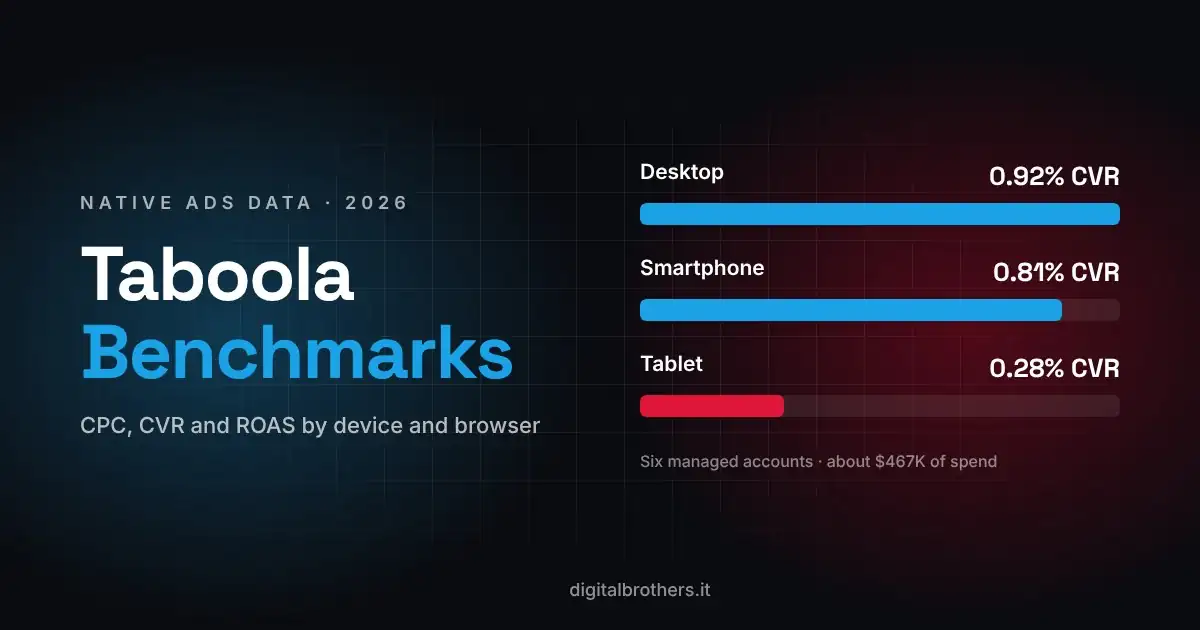
- In-app WebViews and unknown browsers. A page opened inside another app, or a browser almost nobody uses. In our benchmark of three large accounts, WebView converted at 0.14% against 1.09% on Chrome. See the Taboola benchmarks by device and browser.
- Non-human traffic. Visits that never take an action on the page. We cannot prove from Taboola's reports that a click is a bot, so we treat it as a pattern to measure: many clicks, zero conversions and zero engagement events.
A real weekend: $400 and zero conversions
The numbers below come from one US desktop campaign for a health product we manage. The account is anonymised, and the figures use the Taboola pixel.
| Days | Clicks | CTR | CPC | Spend | Conversions | Where it ran |
|---|---|---|---|---|---|---|
| Thursday to Friday | 890 | 0.25–0.40% | $0.60–0.70 | $573 | 11 ($949 revenue) | Yahoo properties |
| Saturday to Sunday | 1,484 | 1.0–1.3% | $0.22–0.35 | $400 | 0 | Long tail of small sites |
On Friday the campaign returned a pixel ROAS of 1.66. On Saturday the CTR roughly quadrupled and the CPC fell to about a third. That combination is the signature of low-quality placements: clicks at 20–35 cents that never buy.
Why it happened
- Weekend on desktop. The Yahoo properties that converted all week are office and home-PC traffic. On Saturday the best property fell from roughly $60 a day to $15, and the broad "run on network" targeting filled the budget with the long tail.
- New ads and automatic bidding at the same time. New creatives went live on the same two days. The bidding algorithm was exploring just as the good inventory disappeared, and learned from cheap high-CTR clicks.
Who converted in the same account, over a week: four Yahoo properties produced 8 of 11 conversions with 42% of the spend. One of them converted 3 times on $87 spent. Linux desktop (Chrome) sent 331 clicks and $117 with zero conversions and zero engagement events. On a desktop campaign for an older audience, we now treat that as a likely sign of non-human traffic, not as proof.
How to find it: three reports, every week
- Site report. Sort by CTR. Anything above 1.5% with a CPC under $0.45, on a campaign that normally runs far lower, goes on the review list. Check conversions and engagement events before blocking: a site with zero conversions after a few hundred clicks is a candidate, a site with one conversion is not.
- Browser report. Look for WebView, launcher apps and browsers you have never heard of. In one of our Canadian accounts a single unknown browser spent $360 in two days for 3 conversions and used the whole daily budget.
- Operating system report. Break desktop down by OS. An OS that sends hundreds of clicks and no events is worth excluding.
Then compare days. A campaign that "got worse on the weekend" has often not got worse: its budget has moved to different inventory. Look at where the money went before you touch the ads.
What to block, and in what order
- Block the long-tail sites that match the signature (CTR above 1.5%, CPC under $0.45, no conversions). In the weekend case above that was about thirty domains.
- Block the browsers and launcher apps that spent without converting.
- Exclude the OS that sends clicks with no events, if it is not converting in your account.
- Limit the days on desktop. If the good inventory is a weekday audience, a weekday schedule keeps the budget off the weekend long tail.
- Change one big thing at a time and give the algorithm a few days. Several changes at once make it impossible to read the result.
Blocking is a list that keeps growing. That is the main reason many advertisers move to the next step.
When a whitelist is the better tool
A whitelist reverses the logic: instead of blocking bad sites one by one, the campaign runs only on a list of approved sites. It cuts the junk and the cost of managing blocks, and the price is volume, because you can only buy what is on the list.
How we use it, in practice:
- Start from sites that already converted in the same account or the same country, not from a generic list.
- Run it as a duplicate campaign next to the broad one, so you can compare cost per acquisition on the same ads.
- Keep the list wide enough. For the Canadian account above, the plan agreed with our Taboola account team was to clone the desktop campaign without the bad browser and run it on 50–80 proven sites.
We are a Taboola partner, and on our accounts the whitelists and premium-inventory filters are applied together with our Taboola account manager, who sets them on request, including a list for a specific country. We do not publish results for these lists yet: the plan above was set mid-October 2026 and we will update this page once the campaigns have enough data.
Why it matters more on health and wellness
Health and supplement advertorials are among the most expensive to get approved and the most sensitive to the audience that reads them. A junk click costs the same as a good one but does not read the advertorial. If you also run on a tight ROAS target, one weekend can erase the week. This is also why we compare Taboola with a second source such as Triple Whale or your store data before judging a campaign. If you are choosing a partner for this, read how to choose a Taboola agency.
Frequently asked questions
What is bot or junk traffic on Taboola?
It is traffic that costs you a click and never takes an action: low-quality sites with very high CTR, in-app WebViews, unknown browsers and sessions that trigger no events. In practice it shows up as high CTR, low CPC and zero conversions.
How do I find junk traffic in my Taboola account?
Review the site, browser and operating system reports every week. Sort by CTR, then check conversions and engagement events for anything that looks too cheap. Compare day by day when a campaign suddenly changes.
What is a Taboola whitelist?
A list of approved sites. The campaign runs only on those sites. It reduces junk placements but limits volume, so it works best when built from sites that already converted in your account.
Should I exclude Linux or tablets on Taboola?
Not automatically. In one of our accounts Linux desktop sent 331 clicks with no conversions and no engagement events, so we excluded it. Tablets converted worst in four of six accounts, as shown in the benchmarks. Check your own data before you exclude anything.
How much can bad traffic cost?
In the example above, $400 in two days on one campaign, with no conversions. On another account one browser took $360 in two days. Your numbers will differ, which is why a weekly check pays for itself.
Want someone to watch this for you?
We are a media team of two brothers and an official Taboola partner, and we check these reports on every DTC account we manage, with direct access to our Taboola account manager. Book a free strategy call and we will look at your site and browser reports together, or see how our Taboola partner agency works.

Claudio Dell'Ariccia
Co-founder & Media Buyer
Claudio Dell'Ariccia is co-founder of Digital Brothers. He runs native ad campaigns on Taboola, Outbrain and MGID every day for e-commerce, lead gen and affiliate brands worldwide.
About Digital Brothers →